もう (mō) can mean “already”; まだ (mada) can mean “not yet” or “still.” To もう食べましたか? (Mō tabemashita ka?) — “Have you eaten yet?” — answer はい、もう食べました。 (Hai, mō tabemashita.) if you have, or まだです。 (Mada desu.) if you haven’t. Read the verb after mada to tell “not yet” from “still.”
A lunch question needs your current answer
A coworker is about to get lunch and asks whether you have eaten. You finished lunch a little while ago.
Coworker: 昼ごはんは、もう食べましたか?
Hirugohan wa, mō tabemashita ka?
“Have you had lunch yet?”
You: はい、もう食べました。
Hai, mō tabemashita.
“Yes, I’ve already eaten.”
Here mō says the action has happened by now. In the question, English naturally uses “yet”; in the answer, “already” fits. You can use the same Japanese word in both turns without forcing the same English translation.
Now change the situation: you haven’t had lunch. Your short answer changes too.
If you want to say you will eat now, add これから食べます。 (Kore kara tabemasu.) — “I’m going to eat now.” The reply gives the other person your status and what comes next.
Make “not yet” explicit with mada … te imasen
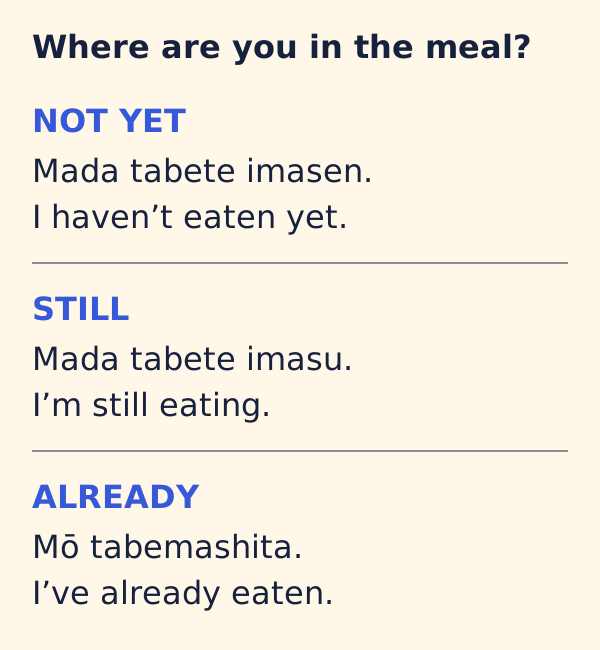
A fuller answer to the lunch question is まだ食べていません。 (Mada tabete imasen.) — “I haven’t eaten yet.”
The verb ending 〜ていません (…te imasen) works with mada to say that the action has not happened by the point you are talking about. Compare two everyday tasks:
| Japanese | Romaji | Meaning | Use |
|---|---|---|---|
もう食べました。 | Mō tabemashita. | I've already eaten. | Lunch is done. |
まだ食べていません。 | Mada tabete imasen. | I haven't eaten yet. | Lunch has not happened yet. |
もう送りました。 | Mō okurimashita. | I've already sent it. | The message has been sent. |
まだ送っていません。 | Mada okutte imasen. | I haven't sent it yet. | The message is still unsent. |
For a beginner’s short reply, mada desu lets you answer before you can build the full verb form. When you use the longer form, keep the ending with the phrase. まだ食べません。 (Mada tabemasen.) can instead mean “I’m not going to eat yet,” holding off on eating. For “I haven’t eaten yet,” choose mada tabete imasen.
Mada with a continuing state means “still”
Your coworker has eaten, but their coffee is still hot. They say:
コーヒーはまだ熱いです。
Kōhī wa mada atsui desu.
“The coffee is still hot.”
Here there is no negative ending. The state — being hot — continues. Translating mada as “not yet” by itself would miss that meaning.
Another example is an action in progress:
まだ食べています。
Mada tabete imasu.
“I’m still eating.”
Notice the difference between まだ食べていません (mada tabete imasen) and まだ食べています (mada tabete imasu). The first says “I haven’t eaten yet.” The second says “I’m still eating.” The ending changes the reply.
Mō with a negative can mean “not anymore”
At the end of lunch, someone offers you more food. You have had enough and say:
ありがとうございます。でも、もう食べません。
Arigatō gozaimasu. Demo, mō tabemasen.
“Thank you, but I won’t eat any more.”
Compare that with mada tabete imasen, “I haven’t eaten yet.” One person has finished eating; the other has not eaten. The whole phrase tells you which situation it is.
You can organize the contrast as a change in status. Mō often points to the new situation that has been reached: already done, or no longer doing something. Mada points to what continues: still doing it, or still not having done it. Keep a concrete example beside that idea so it doesn’t turn into an abstract rule to memorize.
For the polite endings themselves, use the masu-form lesson. Then return to the lunch replies and say the ending clearly.
Answer for three different points in the meal
Close the answers and try those situations in the order 3, 1, 2. You have the contrast when your reply follows the state of the meal, even after the order changes.
For a useful phrase to carry into tomorrow, choose the lunch reply that describes you right now. Say it with its ending. When the situation changes, change the reply too.
Language reference checked November 5, 2026: Japan Foundation, Irodori Elementary 2, Lesson 8, grammar notes, for completed actions, not yet, and continuing states.