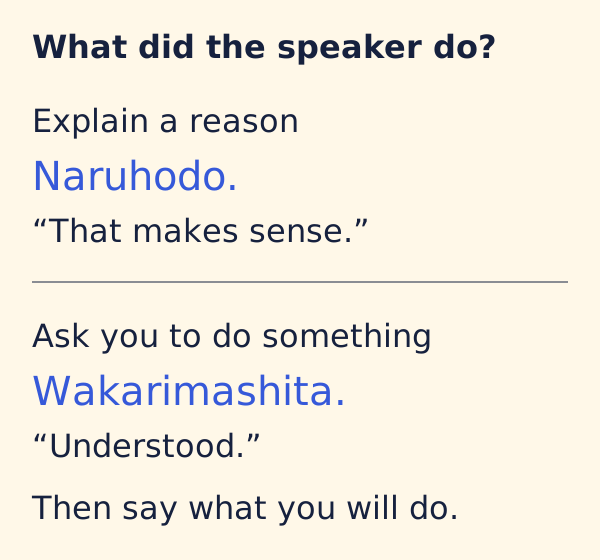
なるほど。 (Naruhodo.) means “I see” or “That makes sense” when you take in an explanation. わかりました。 (Wakarimashita.) means “Understood” and can acknowledge a request. If someone asks you to close a window, wakarimashita lets them know you received the request. Add what you will do: 閉めます。 (Shimemasu.) — “I’ll close it.”
Both replies can follow something you understand. The useful difference is what the other person needs from you: a response to their explanation, or an acknowledgment that leads to an action.
When a reason clicks, try naruhodo
You wonder why a friend chose a small bag for a day out. The friend gives a reason.
Friend: 今日はたくさん歩くので、小さいかばんにしました。
Kyō wa takusan aruku node, chiisai kaban ni shimashita.
“We’ll walk a lot today, so I chose a small bag.”
You: なるほど。軽くていいですね。
Naruhodo. Karukute ii desu ne.
“That makes sense. It’s nice and light.”
The explanation connects the bag choice to the walking you will do. Your reply recognizes that connection and adds a comment. You haven’t agreed to carry the bag or buy one yourself.
Naruhodo is often written in hiragana. The dictionary spelling is 成る程. In ordinary replies, keeping it as なるほど is easy to read. Shogakukan’s Digital Daijisen entry describes its use in receiving and agreeing with another person’s point.
When someone requests an action, acknowledge it clearly
At home, a person sharing the room asks you to close the window. You understand the request and are happy to do it.
Other person: 窓を閉めてください。
Mado o shimete kudasai.
“Please close the window.”
You: はい、わかりました。閉めます。
Hai, wakarimashita. Shimemasu.
“Okay. I’ll close it.”
The request already tells you what action is wanted. Wakarimashita acknowledges that you have understood; shimemasu makes your next action explicit. A bare naruhodo could leave the person waiting to learn whether you will close it.
The Japan Foundation’s Nihongo de Care-navi entry for hai, wakarimashita also shows an acknowledgment after someone asks for another person’s help. Your next sentence can make the particular action clear.
Can wakarimashita also follow an explanation?
Yes. If a teacher explains how an exercise works, わかりました。 (Wakarimashita.) can tell them that you now understand. It belongs after explanations as well as requests.
You can even put the two replies together when an explanation has helped something make sense: なるほど、わかりました。 (Naruhodo, wakarimashita.) — “I see. I understand now.” There is no need to choose a different phrase merely because you heard new information.
For a polite acknowledgment to someone you don’t know well, はい、わかりました。 (Hai, wakarimashita.) is a useful starting point. To thank someone for explaining, add ありがとうございます。 (Arigatō gozaimasu.) — “Thank you.”
Naruhodo can put the focus on your reaction to the explanation. In a formal request, a clear acknowledgment and the next action usually do the job more directly. You don’t have to learn a list of forbidden words to make this choice.
If one part is still unclear, ask before closing the exchange
Imagine being asked to put a bag beside a chair. There are two chairs, and you aren’t sure which one the speaker means. Saying wakarimashita and guessing would hide the part you still need to check.
You: どちらの椅子ですか?
Dochira no isu desu ka?
“Which chair?”
Other person: 窓のそばの椅子です。
Mado no soba no isu desu.
“The chair by the window.”
You: わかりました。
Wakarimashita.
“Understood.”
Now your acknowledgment follows the missing detail. If the problem was speech you missed, use the repeat and speak-slowly phrases to recover it first.
Pick a reply for the reason, the request, and the gap
For one last try, read only the situations above and say your replies without opening the answers. Success means matching the reply to the purpose, and asking for the missing detail when there is one.
| Japanese | Romaji | Meaning | Use |
|---|---|---|---|
なるほど。 | Naruhodo. | That makes sense. | Receive a point or explanation that now makes sense to you. |
はい、わかりました。 | Hai, wakarimashita. | Okay, understood. | Acknowledge that you understand, including after a request. |
どちらの椅子ですか? | Dochira no isu desu ka? | Which chair? | Clarify the specific chair before acting. |
Before your next exchange, keep one distinction in mind: did someone explain a reason, or ask you to do something? Let your reply show which one you understood. If an action is waiting, name it and follow through.